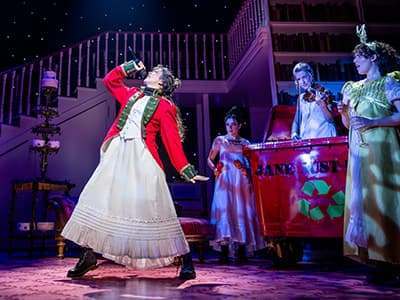
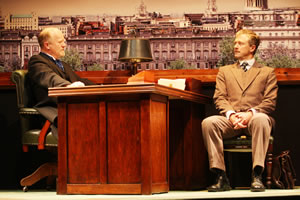
 Left - Gary Baxter & Drayton Morley. Cover - Mark Lee & Katie Fitchett. Photos - Steve Lunam
Simon Gray’s Little Nell is the tale of Charles Dickens and his almost three decades younger mistress Ellen Ternan, his own “Little Nell”, and the impact this had on their lives.
Framed by a running scene set in 1922 that threads through the entire play, we meet Geoffrey Robinson, son of “Nell” and her later husband George Robinson, who discovers after both his parents’ deaths that his mother had some mysterious connection to the legendary writer, of which he was totally unaware. Seeking answers, he visits Dickens’ son Sir Henry, a successful lawyer, who initially presumes him to be the latest of many frauds claiming to be illegitimate children of his father. As it turns out they actually are “stepbrothers” of a sort, although not blood relations and a generation apart, being the children of these two great lovers but by separate unions. Geoffrey, an awkward, stuttering man, finds himself overwhelmed to discover that his mother had a whole other life, having lied about her age to his father and thus “erasing” more than a decade of her life that she had spent with Dickens.
Against this frame we see scenes that range from the initiation of Nell’s affair with Dickens through to his death and then beyond, into her troubled marriage with George. These scenes are mostly two-handers, supplemented by an opening dramatisation of Dickens’ work (the context in which he first met Nell, a young actress) and solo dramatic readings which the author famously delivered to packed houses. We see various aspects of their relationship and gain further insight into its ramifications from the accounts of their separate children who appear to “watch” this action from the present day of 1922. We view the illicit partnership’s difficulties against not only the moral climate of the day, but also exacerbated by Dickens’ extraordinary fame in his own lifetime, making formal divorce from his own wife impossible despite their being separated to all intents and purposes. As other characters elaborate, this was made all the more problematic due to Dickens’ public image as a “great man” whose work was of exemplary moral rectitude and incalculable significance to the British public. To besmirch such a reputation, even posthumously, was deemed to be unconscionable, regardless of it representing the truth.
Perhaps one of the most interesting aspects to this play is the contrast between what seems – perhaps artificially so – to be an odd contrast between these restrictions of Victorian morality and some seemingly quite “modern” elements in its unromantic view of love. Specifically, there is a curiously overt sadomasochistic element to Nell’s affections towards Dickens, which begins with a little game of tugging at his beard but escalates to actions such as forcing him to his knees and roughly pulling his head back by the hair, with clearly eroticised overtones. To what extent this is entirely spelled out in the script or may be an extrapolation by director Mark Kilmurry is not clear, but this S&M frisson certainly adds an intriguing element to their relationship.
Indeed, it is one of many aspects of this play’s multifaceted look at a union that, while on the surface is the seemingly inequitable one of a famous man and his much younger secret mistress, proves to be an emotionally complex lovematch. More than a muse, she is depicted as having the brains and vigour that Dickens’ wife reportedly lacked, and was his equal as much as his disciple. As portrayed by Gray, theirs is a relationship that, for all the damage it did to their lives both before and after Dickens’ death, had a genuine love and mutual admiration at its core.
If anything, the play suffers a little from its overly episodic structure, being comprised of unconnected vignettes that alternate somewhat in emphasis and perspective, showing significant moments in Nell’s life both with Dickens and later George in an interwoven chronology. One feels that we are only being offered glimpses of the whole story, and some significant details (such as possible children from the affair) remain alluded to but not spelled out. Furthermore, the narrative perspective seems slightly unclear, as historical scenes outside of the 1922 frame are not exclusively from Nell’s personal experience. Although serving to flesh out the story, these scenes somewhat confuse the question of whose story this is. Is it Nell’s? Is it Geoffrey’s? Perhaps neither, and yet both. Probably the fairest assessment would be that it is the story of Nell and Dickens’ relationship itself, and the consequence it had on her later life and progeny.
By avoiding devices of narrative compression that seek to make sprawling biographies into “complete”, continuous narratives, Gray’s play seems more like a glimpse of key chapters in an overall tale, fragments of an incomplete book. This is clearly a deliberate artistic choice, and while it may seem unsatisfying to some, it has its strengths in escaping the imposed artificialities of more conventional narratives or the structural pitfalls of a standard melodrama.
Mark Lee – a very fine actor we see far too little of these days – is excellent in the role of Charles Dickens, bringing considerable depth to a performance that could easily become arch or overblown, given the character’s inherently grandiose proclivities. In Lee’s capable hands, Dickens soars and dives from ecstatic highs to deep distress, and banks into overt theatricality when delivering some of his famous public readings of his work. Perhaps most impressive of all is Lee’s transformation from the middle-aged Dickens of the majority of the play to the infirm man who worked himself into an early grave more than a decade later, having become old before his time.
Although her character is at times a little inscrutable, Katie Fitchett is also perfectly cast as Nell, similarly playing a convincing range of ages between a precocious 17 and an alternately steely and distraught 44. It is a difficult character to pull off, but Fitchett does so with aplomb.
The supporting actors are all very good, in particular Gary Baxter as the sympathetic yet quintessentially English Sir Henry Dickens, and Drayton Morley who nicely distinguishes his dual roles as the uptight Geoffrey Robinson and his emotionally unbalanced father George.
While its “narrative snapshot” approach may leave some a little dissatisfied, Little Nell is a strong play that has, if anything, been elevated by the engrossing performances of a first-rate cast.
Ensemble Theatre presents
LITTLE NELL
By Simon Gray
Director: Mark Kilmurry
Venue: Ensemble Theatre, 78 McDougall Street, Kirribilli, NSW, 2061
Dates: Previews: Jan 29 – Feb 5, opens Feb 6, plays to March 14.
Performances: Tue–Fri 8.15pm, Sat 5pm & 8.30pm, Sun 5pm, Thurs 11am
Prices: $39 - $63 (booking charges may apply)
Bookings: 02 9929 0644 or www.ensemble.com.au